Inox is here to stay
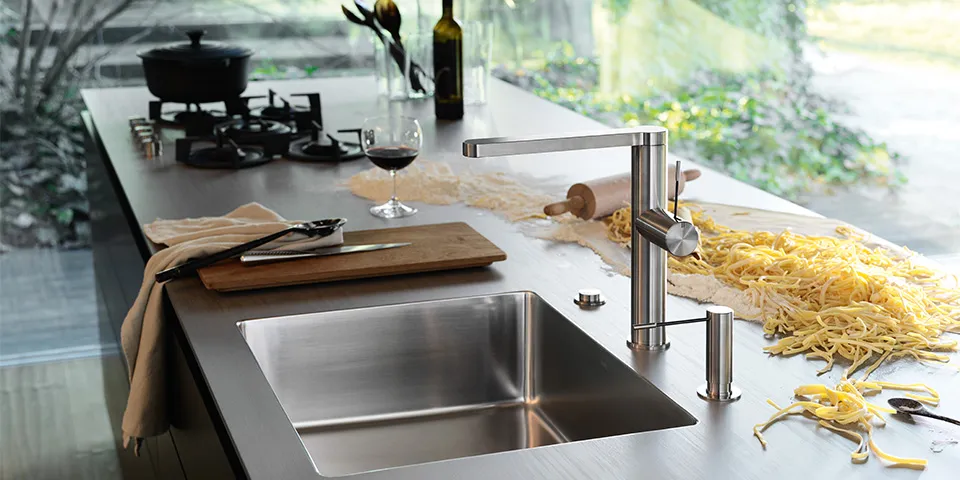
We can no longer ignore it. Kitchens in stainless steel, long the most widely used material in professional settings, are increasingly being considered for new domestic kitchens. A worktop, a sink or an entire kitchen in stainless steel: anything is possible.
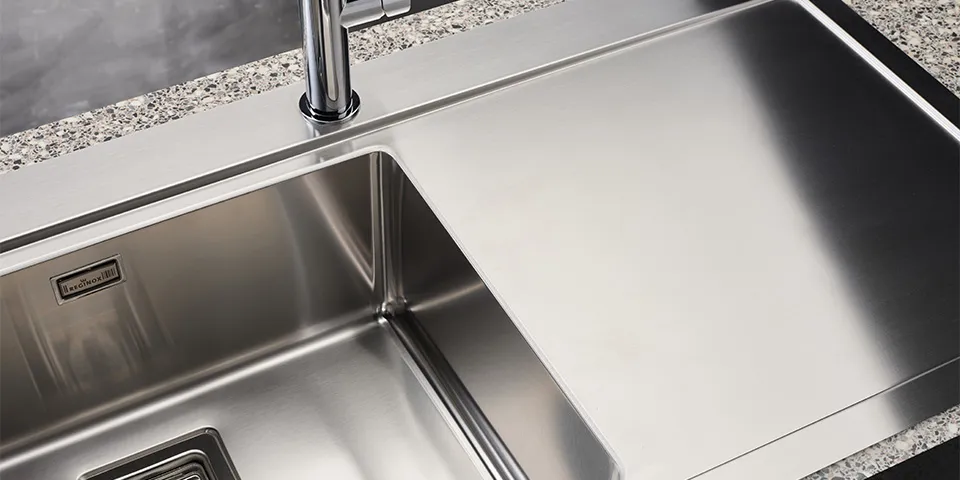
Stainless steel combined with other materials produces an attractive result. (Image: Reginox)
Call it inox, stainless steel or rust-resistant steel: these different names all refer to the same material, with the same properties. There is no doubt that stainless steel is a strong, high-quality material. Add to that its excellent hygiene and low-maintenance qualities, and you have its three most highly valued features. Other properties that make it useful in kitchens include its resistance to heat (though take care not to place boiling-hot pots and pans directly on the surface: a trivet is a good idea), its resistance to acids and water (the latter goes without saying), and its exceptional durability. In kitchens that are used frequently, however, the worktop and sink will show signs of use. Scratches are inevitable: knives, wire wool, keys and so on will leave their mark. But those who opt wholeheartedly for a stainless steel kitchen say that this is precisely what gives it its charm.
What is stainless steel?
Stainless steel is an alloy of iron, chromium, nickel and carbon. Wikipedia also explains that steel can only be called rust-resistant if it contains at least 11 to 12 per cent chromium and no more than 1.2 per cent carbon. Its resistance to rust develops when the chromium comes into contact with oxygen. This immediately forms an invisible layer of chromium oxide, also known as the passive layer.
Oxidation usually damages a material, as happens with rust. In some cases, however, the oxide layer protects against various other forms of attack. That is what happens with the layer of chromium oxide. It acts as a barrier against moisture, protecting the underlying metal from further rusting (oxidation). This combination of properties makes stainless steel a smart choice for use in kitchens. The material is also used in a wide range of applications: the food industry, mechanical engineering, ironmongery, fasteners, shafts, fittings, machinable components, the pharmaceutical industry, construction, and the chemical and petrochemical industries.

No problem if you tend to spill things while cooking: a stainless steel worktop is very easy to maintain.
Looks matter too
The balance between a material’s positive and negative properties has a major influence on the choice. Does the balance tip in its favour or not? Aesthetics and design also affect that balance, or to put it simply: does the end result look good? If the answer is no, that material is highly unlikely to be chosen, at least for a domestic kitchen. If the answer is yes, the mix of properties does not necessarily have to be the best. The combination of properties and aesthetics that appeals most to the customer wins out. Looks matter too, and they are usually the deciding factor. Stainless steel is ideal for bespoke work. A sink can be seamlessly welded in, a draining area can be incorporated or grooves can be used instead, and cut-outs can be made in the right places for a hob, teppan yaki, sockets and much more.
Question about this story? Ask your question
Companies in this story

Keep following this
Get an email when a new story is published. No account needed.
- SubjectGeneral
- CompanyReginox