From professional kitchens to the home
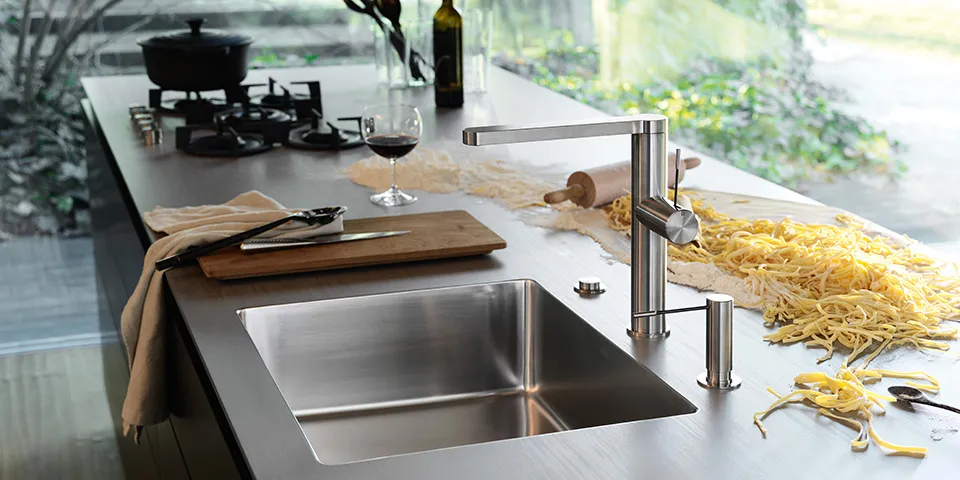
A material that has made the transition from professional kitchens to the domestic market: stainless steel. It is the basis for taps, sinks, worktops and splashbacks. This is how a complete stainless-steel kitchen takes shape.
The online encyclopaedia Wikipedia refers to stainless steel as ‘rust-resistant steel’. After all, ‘rust-free’ also applies to ‘ordinary’ steel that has not yet rusted. However, the term ‘stainless steel’ is so firmly established that we will continue to use it. The first stainless steel was cast on 13 August 1913 by Harry Brearley in the laboratory of Brown-Firth. The circumstances, however, were less pleasant: stainless steel was developed as part of research for the arms industry.
An invisible layer
Stainless steel and ‘ordinary’ steel are produced in much the same way, but there is one important difference. Chromium and nickel are also added to stainless steel. The chromium makes it resistant to rust. When it comes into contact with oxygen, an invisible layer forms on the surface of the steel. This is chromium oxide, which protects the underlying metal from rust. Better still, it repairs itself when damaged. The addition of nickel and, potentially, other elements further increases corrosion resistance.
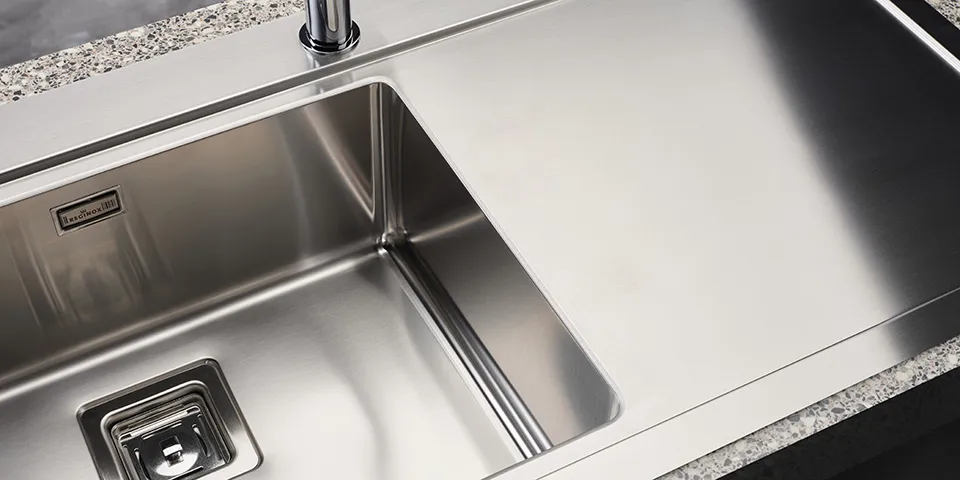
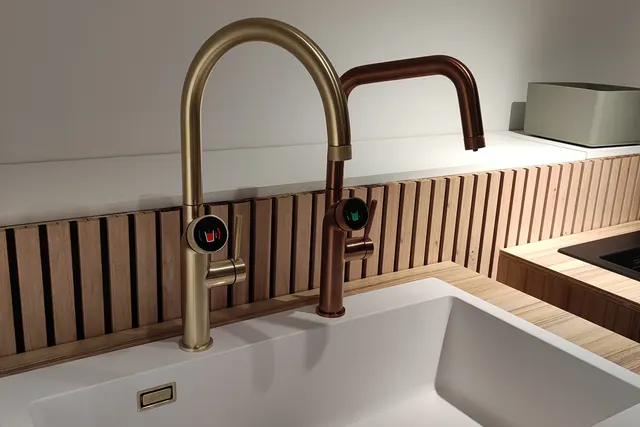
Stainless steel combined with other materials makes for an attractive result. (Image: Reginox)
The appeal explained
Stainless-steel kitchens are commonplace in commercial kitchens, the hospitality industry and, especially, top restaurants. Many Michelin-starred restaurants design their own kitchens, including the layout of all appliances and sinks. They rely on specialists’ expertise both to guide the planning and to ensure that production and installation are carried out flawlessly, down to the smallest detail. The material’s outstanding properties explain why it is so popular in professional settings.
Stainless steel is extremely strong and hard-wearing, withstands both high and low temperatures, is resistant to acids and, of course, is impervious to water. It is also easy to maintain, making it highly hygienic. Another major advantage is that stainless steel pairs beautifully with materials such as marble and granite. It also works well with wood to create attractive designs.
These very qualities also explain why stainless steel is gradually winning over homeowners. However, a complete stainless-steel kitchen still seems more suited to commercial kitchens and restaurants, where its somewhat cool feel matters less. Of course, tastes differ, and consumers may well choose to go entirely for stainless steel.
Accents in the kitchen
A kitchen made entirely of stainless steel may be a step too far for many consumers. That is understandable, given the cooler feel the material conveys. Some find it unwelcoming, while others choose it deliberately. The material’s excellent properties are another strong reason to opt for it. As various manufacturers produce worktops, sinks, taps and splashbacks, customers can put together a kitchen that combines stainless steel with another material. One possible combination is a granite worktop with a stainless-steel sink and matching tap seamlessly integrated into it.
Question about this story? Ask your question
Companies in this story

Keep following this
Get an email when a new story is published. No account needed.
- ThemeMaterials and finishes in balance
- SubjectKitchen appliances
- CompanyReginox