Say goodbye to unwanted cooking fumes!
The look of the kitchen has changed dramatically in recent years. What happens in a kitchen is no longer the same as it was, say, 20 years ago. Today, the kitchen is often the beating heart of the home. We still cook there, and we still want to stop cooking fumes and odours from spreading through the room. Cooker hoods are therefore essential, and they too have evolved considerably in recent years.
A domestic appliance in the kitchen that removes cooking odours. That is how Wikipedia describes a cooker hood, also known as an extractor hood. The page goes on to list the ‘rules’ to bear in mind when installing one. It should be at least as wide as the hob, and there must be a minimum distance between the hob and the hood. The page’s outdated nature is immediately apparent. It makes no mention of the option of a wall-mounted cooker hood, let alone a worktop extractor. These are recent developments that are nevertheless gaining in popularity.
Say goodbye to cooking odours
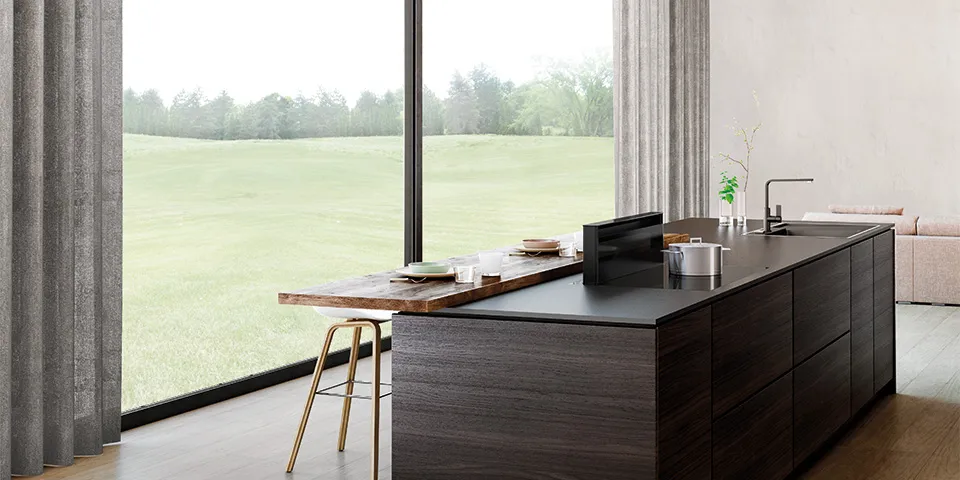
The Novy Panorama features a height-adjustable ventilation tower that retracts completely into the hob when not in use.
The most important quality of any cooker hood, whatever the type, remains its ability to efficiently remove the fumes and odours produced during cooking. No one wants a kitchen, or an entire living room when the two form one open-plan space, where you can still smell what was cooked hours later. Ideally, this should happen as quietly as possible, so we do not have to shout to make ourselves heard while cooking or enjoying a meal together. Everyone agrees on these two qualities, but which type of cooker hood is ‘best’? How do you choose what you want from the long list of options?
Above or built in
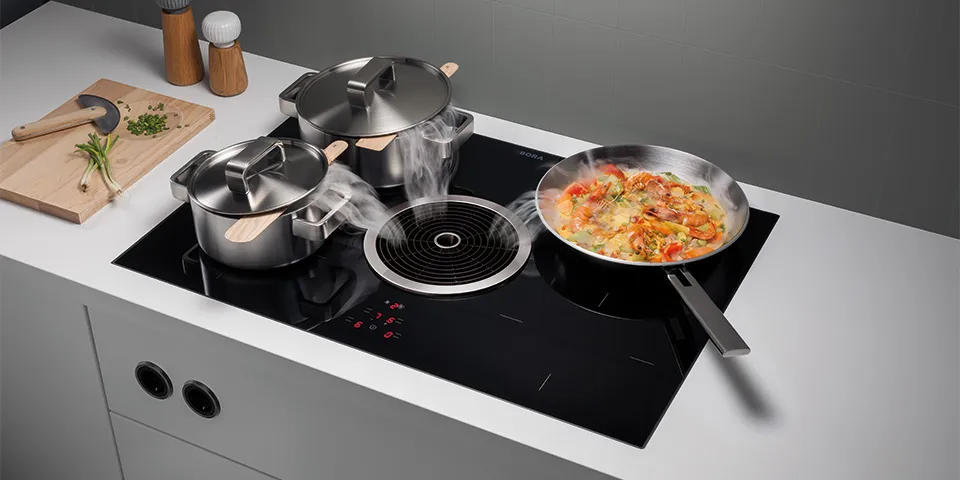
Many cooker hood manufacturers were exhibiting at the latest edition of Batibouw. When asked which type is actually best, almost all gave the same answer. “Cooking fumes form over the hob and then rise, that’s nature”, was a frequent response. “Let nature take its course, and we’ll make sure they are efficiently removed with a cooker hood above the hob.” At the same time, manufacturers said that increasingly popular hob extraction removes cooking fumes right at the hob, preventing them from spreading into the room. A sufficiently powerful extractor can counter this effect. Only two exhibitors gave a clear answer when asked which type of cooker hood they preferred. BORA is firmly committed to hob extraction. This German manufacturer focuses entirely on this type and offers only hob extractors. Wave Kitchen Products, by contrast, favours decorative cooker hoods, both those installed above the hob and wall-mounted models. Wave’s position is nuanced: it does not necessarily consider the ‘traditional’ approach better, but says it is more in keeping with its vision. “Our cooker hoods add value to every kitchen”, the company says. “They make a statement, they are real eye-catchers, and they do their job efficiently and quietly.”
Technology
A cooker hood is more than just a cooker hood. It is the result of an extensive development process, in which manufacturers spare no effort or expense to perfect the technology. Consider the filters and the way air flows through the hood, for example. Where air is extracted to the outside, ingenious solutions are also used to make the process as efficient as possible while preventing (large amounts of) cold air from entering the home through the hood. German manufacturer Naber does not make cooker hoods, but focuses on developing and producing accessories and systems that extract cooking fumes outdoors while keeping cold air out. These are designed for both traditional cooker hoods and worktop extraction systems. For those without an outlet to the outside, there are manufacturers specialising in filters, such as the Dutch company PlasmaMade. BORA has also developed a new filter system, designed to make it very easy to remove and replace the filters.
One thing that immediately stood out during visits to Living Kitchen and Batibouw was the number of cooker hoods that communicate with the hob. Thanks to this connection, the hood automatically adjusts its extraction rate to the conditions and the amount of cooking fumes.
Design
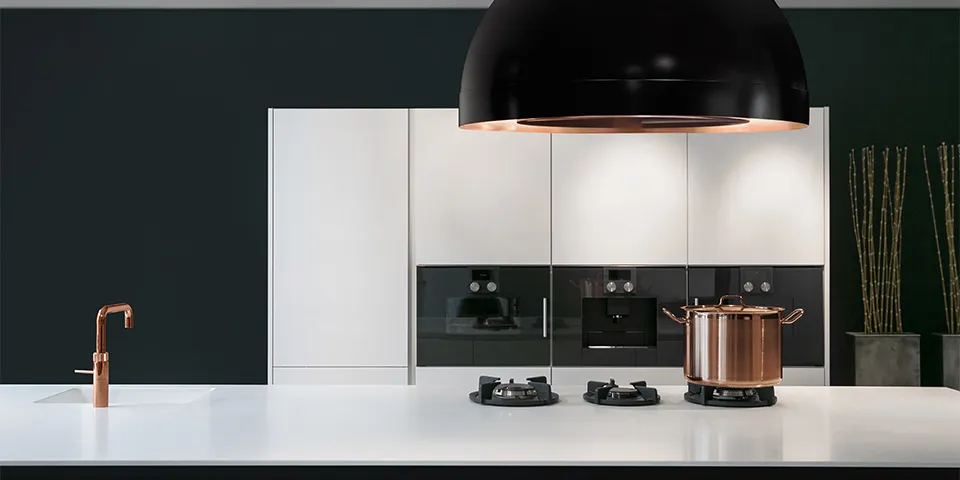
Wave cooker hoods, real eye-catchers in the kitchen.
Today, cooker hoods not only have to do the job they were designed for, they also have to look good. Design is becoming increasingly important for every type of cooker hood. The trend towards kitchens and living rooms merging into one large space has certainly had an influence. But it is not just about the appearance of the hoods. Their controls also need to be user-friendly and intuitive, preferably with an attractive design language. All manufacturers clearly pay close attention to design. The many international awards they have won are proof of this. These design awards naturally assess the shape and appearance of the appliances, but also take into account innovative technologies and systems, ease of use and all the other aspects that matter in today’s cooker hoods.
The customer is king
Ceiling-mounted units, built-in and under-cabinet cooker hoods, decorative wall-mounted hoods, decorative island hoods, worktop extraction… The choice facing consumers is not an easy one. Many manufacturers, including Belgian company Novy, offer products for every application. In effect, they put the choice in the consumer’s hands, but they do not leave them to figure it out alone. Various retailers and manufacturers have developed handy cooker hood selection guides that help consumers make the right choice through a series of steps.
Question about this story? Ask your question
Companies in this story


Keep following this
Get an email when a new story is published. No account needed.
- ThemeCooking with smart appliances
- SubjectLighting
- CompanyNovy
- CompanyNaber