Physics in the kitchen

When designing a kitchen, there are many choices to make. Worktop, sink, appliances, extractor hood, taps, island or no island, … You also need to consider how you are going to cook. On the following pages, we take a closer look at induction cooking.
Induction is a physical phenomenon in which an electrical voltage is induced across a conductor when it is in a changing magnetic field or moves through a magnetic field. Transformers and generators, for example, are based on this principle. Michael Faraday is regarded as the ‘discoverer’ of the phenomenon, while William Stanley Jr. is considered the forefather of induction cooking. When an electrically conductive object is heated by means of an electric current induced within it, this is known as induction heating. Induction cooking is its best-known application.
How does an induction hob work?
Physics in the kitchen helps us prepare a tasty meal. Beneath the sleek surface of an induction hob lies a complex system that converts mains electricity into the heat needed to warm pots and pans. Electrical coils, positioned horizontally like the hob itself, convert the mains voltage into a voltage at a different frequency. This produces an alternating current at the same frequency and, at the same time, a vertical magnetic field. The interaction between the two creates an eddy current that flows through the base of the pan or pot. The resistance of the base converts this current into heat. Only the pan or pot is heated, not the whole hob, so little energy is wasted.
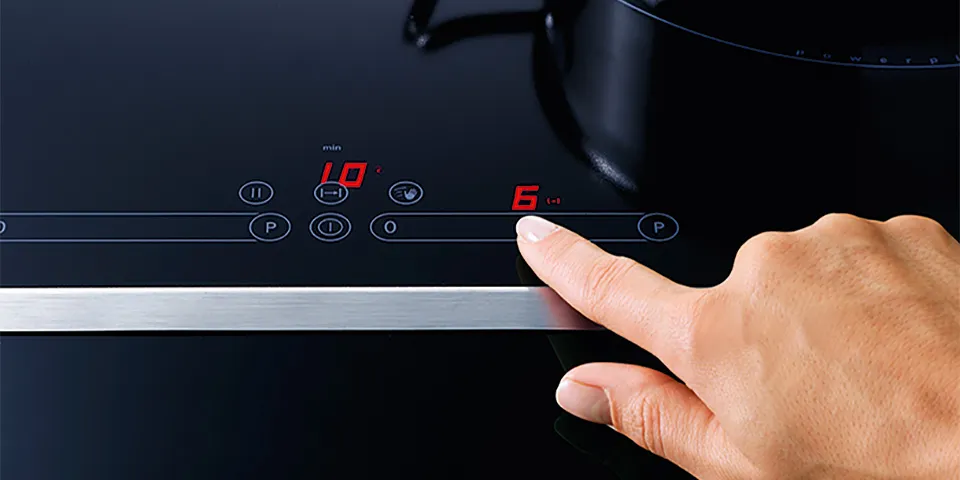
Easy to use, both in terms of controls and cooking performance.
Advantages at a glance
Induction cooking is becoming increasingly popular, and it is easy to see why when you consider some of its advantages. As mentioned above, little energy is wasted with this cooking method. Electricity is only used when the hob is switched on, and it goes towards heating the pots and pans. No more than necessary, and no longer than necessary. Once the hob is switched off, it stops consuming energy immediately. Induction is also more efficient, as a simple test anyone can carry out will show. Water boils faster on an induction hob than, for example, on a gas cooker. Induction cooking is also generally considered a safe way to cook. Pots and pans get hot, and the hob also reaches a high temperature. But when the hob is switched off, it cools down again relatively quickly. An additional safety feature may be a system that detects whether a pan or pot is actually positioned over a coil. This can be determined by measuring whether sufficient energy is being absorbed. If not, the appliance can switch itself off. Please note: this feature is not included as standard among the available functions.
Manufacturers usually cover induction hobs with a heat-resistant glass-ceramic surface, which is also easy to clean.
Disadvantages
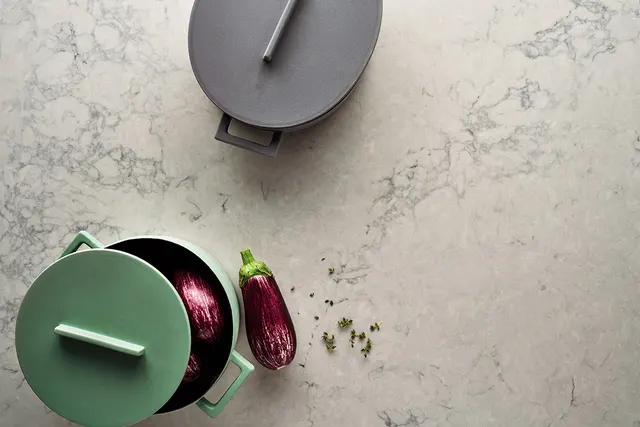
Not all pots and pans are suitable. Anyone choosing an induction hob, or switching from a gas cooker to an induction hob, for example, will also need to buy new pots and pans. For optimum heat transfer, the base must be magnetisable and preferably thick enough to distribute the heat generated effectively. In other words, you need induction-compatible pots and pans. A simple test can help you work out whether a pan is suitable for use on an induction hob. All you need is a strong magnet. If the magnet sticks to the base of the pan, it is magnetisable and will work on induction. If it does not stick, the pan will not work, or will not work efficiently enough. These days, manufacturers mark their pots and pans with a special symbol to make it immediately clear that they are suitable for induction.
Question about this story? Ask your question
Keep following this
Get an email when a new story is published. No account needed.
- ThemeKitchen design for everyday life
- SubjectWorktops